66246772

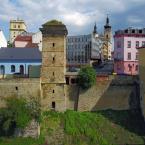
Old water tower in Mladá Boleslav
Vodkova 127
Mladá Boleslav, 293 01
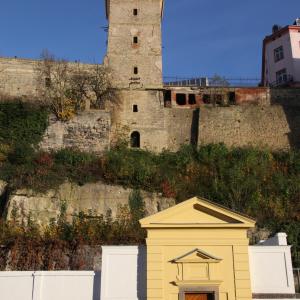
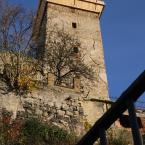
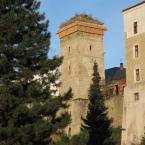
The old water tower built in the first half of the 18th century is the oldest remnant of the historical municipal watermains, which are among the oldest in the Czech Republic. It served its purpose for more than 170 years.
The first, wooden water tower was built on the town walls above Podstupenský mill (Mill below the Steps) in 1496 by Adam Tovačovský of Cimburk. The water tower was part of the manorial watermains. The spring flowing from the rock crevice opposite the mill was the source of drinking water. Castle servants and residents of the original settlement established below the castle collected water from this spring. For 160 years after the town was moved to the promontory the residents had to walk down the steep slope using primitive steps to collect water below the town walls. These steps gave the spring and the mill their name. The manorial watermains were only built around 1494. The water tower was built next to the mill and the spring was redirected to the water tower. A pumping machine powered by a water wheel delivered water to the reservoir in the water tower. From there, water flowed for a long time to two fountains only – the municipal and the castle fountain.
As the manorial watermains were no longer sufficient for the needs of the town during 1554-1555, Arnošt of Krajek initiated its reconstruction, which was completed by his sons, including the construction of the new water tower in place of the original wooden tower. The appearance of the water tower is captured on the famous Willenberg’s veduta of the town from 1602.
The water tower collapsed in 1721. As Karel of Krajek handed the watermains over to the town for a fixed payment of 20 threescores of groschen per year in 1576, the new water tower was constructed at the town’s expense. In 1723, the local builder Mikuláš Rossi built the tower in the baroque style according to the design by Pavel Ignác Bayer at the town’s expense.
This event is commemorated on the damaged and poorly readable plaque fitted above the entrance to the water tower.
The municipal watermains were only reconstructed in 1874. The watermains with outdated technology and lacking maintenance were insufficient due to the influx of labour force from the countryside serving the local industry. The watermains were equipped with a new pumping machine, the wooden water pipes to the water tower and the fountains were replaced with cast-iron pipes and the staircase and the ceiling below the reservoir in the water tower were repaired. Podstupenský spring with reinforcement from several newly captured springs remained the source of water.
Despite the high cost of reconstruction of the watermains, the volume of the water tower’s accumulation tank became insufficient within a short period of time. The town decided to acquire the mill, rebuild the entire building for the purposes of the waterworks and excavate a new collection well with a new covered channel leading to the waterworks. Constructing a new water tower at the highest location in the town with a reservoir with a volume of 200 m3 was the most important decision in this project.
The project work commenced in 1895 and was finalised one year later. Podstupenský spring remained the source of water.
However, the limited capacity of the spring was soon insufficient for the town’s needs and the water analysis performed after several typhoid epidemics confirmed that the water was contaminated.
Following the necessary surveys and analyses, a dug well with sufficient capacity was constructed in Choboty valley in 1906. A pumping station, an apartment for the attendant, a new ground water tank and watermains leading to Podstupenská waterworks were constructed.
Only then Podstupenský spring that served the needs of the local residents from the beginning of the 11th century was no longer in use.
Although the portal at the entry to the collection well was repaired as part of reconstruction of Ptácká street, the old water tower, which is private property, is in state of disrepair.
Ing. Otakar Pavlík