66246772

Hop Drying House in Dubá
Dubá, 471 41
| Phone: | +420 487 870 490 |
|---|---|
| E-mail: | [email protected] |
| Web: | http://www.mestoduba.cz/informace-pro-turisty/kulturni-pamatky/ |
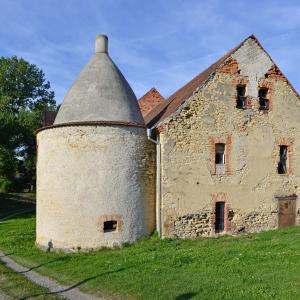
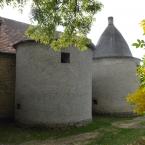
The hop drying house, featuring two drying towers, is an important technical monument that commemorates the former glory of hop growing in Dubá. This tradition also influenced many local folk buildings in the area.
The oldest written record of the existence of a hop drying and sulfurizing house on the southern edge of the town of Dubá dates back to 1877. At the height of hop production in Dubá, there were six drying and sulfurizing houses documented, but only this one has survived more or less in its original state, making it a valuable technical monument.
Hop cultivation in the Dubá region has a centuries-old tradition. It expanded after the Thirty Years' War and reached its peak in the first half of the 19th century. The hops grown included the Dubský zeleňák variety, also called zelenáč, which was a coarser type with a distinct garlic aroma. Its advantage was good storability without loss of quality. By the late 19th century, hop traders increasingly demanded a finer variety called červeňák, which did not thrive in the Dubá area. Nevertheless, the tradition of hop growing in Dubá continued until 1945. Along with hop cultivation, large hop markets also developed in Dubá. Hop growing and trade were mainly conducted by the local Jewish, German-speaking community.
Hops were mostly grown on poles. Originally, harvested hops were dried in the attics of houses, which influenced the architecture of the region. After the mid-19th century, hops began to be dried with warm air in specialized drying houses and preserved by sulfurizing. This led to the construction of several large hop drying and sulfurizing facilities in the Dubá region. One of these was Heller’s drying house, now a bottled water facility. Another large facility, Hahn’s drying and sulfurizing house, stood behind today's Zahradní street, of which only ruins remain. In the 1870s, a drying house was built on the southern edge of the town — today a cultural monument, valued as the best-preserved building of its kind. It currently bears the address number 195, originally it was number 256. Opposite the drying house was the old plague cemetery, marked by a large wooden cross, and a road ran past the drying house to the Vrabcov mill.
According to surviving plans, the original construction included a rectangular building and one round drying tower. The owners and likely builders were the Langhans family from house no. 133 in Dubá, who sold it in 1877 to Josef Grundfest and Anton Sommer. They expanded and completed the drying house in its current form by 1899. The drying house changed ownership several times, and before World War II, it was bought by the hop growers’ cooperative. In 1943, it was acquired by the Hopfenverkehrsgenossenschaft company in Dubá.
After the war, the drying house became the property of the Agricultural Storage and Production Cooperative in Dubá, and later was taken over by the State Farm Dubá, which operated a broiler chicken farm on the premises.
Due to long-term neglect, the structure of one drying tower collapsed, the second tower and the roof of the building were also damaged. Before transferring ownership to the town of Dubá, the State Farm carried out partial repairs on the better-preserved tower. In 2008, the town of Dubá secured the second tower and repaired the roof covering and sheet metal work.
After a year and a half of project preparations, a building permit was issued at the beginning of 2011 for a revitalization project of the drying house and its surroundings.
Currently, restoration work is ongoing with funding from the Czech Ministry of Culture and the Liberec Region.
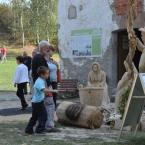
In autumn, the hop drying house hosts European Heritage Days, when the building is open to the public.