Bicycle trip along the ancient Marian Way
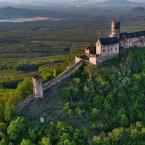
You will follow the route No. 25 in the direction of Břehyň, pass the first crossroads of cycle routes No. 25 and 3045, pass the U Tří provic (Three Pines) farm and follow the pleasant narrow asphalt road to the so-called Marian Way at km 5. After 1.5 km you will come to the second crossroads of routes 25 and 3045. Here you go straight ahead, pass the turn-off of the route No. 3045 in the direction of Bezděz and continue along the forest path straight ahead until you reach the road Bělá - Kuřivody (11.5 km). Go straight across the road into the forest and continue along the Mariánská cesta until you come under Radechov (a 392 m high hill). After a steep short climb on an unpaved forest road you will arrive at Radechov to the grove. From there, take the asphalt road down to the road Bělá p. Bezdězem - Dolní Krupá, turn right and go to Bělá pod Bezdězem. Here you will join the cycle route No. 3045 and follow it to the village of Bezděz. From Bezděz, take cycle route No. 0060 to the turn-off to Bezděz train station, continue straight on route No. 0061 to the turn-off to Pankrác. Here you will join cycling route 0014 on the right and follow it along a narrow asphalt road through Okna, Obora to Doksy.
Worth a look:
Mariánská cesta - an ancient trade route connecting Doksy with Mnichovo Hradiště, two points of the Wallenstein estate. It may have got its name from the paintings depicting the Virgin Mary that were nailed to trees along the road.
Radechov - a hill (392 m) covered with beech forest, among the 24 bird species found, the most rare is the protected wood pigeon. In 1999 Velký Radechov was declared a natural monument. The whole area was a military base until the early 1990s. Before that, Radechov was used as a hunting ground, for this purpose a hunting lodge was built in the mid-19th century near the border road.
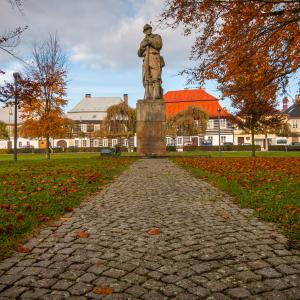
Bělá pod Bezdězem - The town of Bělá pod Bezdězem was founded by transferring the rights of the town, which was situated at the foot of the Bezděz hill and suffered from lack of water, to a place by the Bělá stream. King Wenceslas II gave permission for this in 1304.