Mnichovo Hradiště Loops
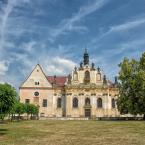
Loop No. 1
Route:
Mnichovo Hradiště – Sychrov (local blue cycle route – 3.2 km) – Březina (local blue – 7.7 km) – Valečov parking (local blue – 12.9 km) – Lhotice (local red – 16.2 km) – Mnichovo Hradiště (local red – 23.6 km)
Loop No. 2
Route:
Mnichovo Hradiště – Klášter Hradiště nad Jizerou (17B GWJ – 3 km) – Mukařov, Borovice (241 – 8.1 km) – Horní Rokytá (unmarked – 15.6 km) – Dolní Rokytá (unmarked – 20.2 km) – Dolní Krupá (unmarked – 21.4 km) – Bílý kříž (unmarked – 24.9 km) – Klokočka (green hiking trail – 27.9 km) – Klášter Hradiště nad Jizerou (241 – 32.1 km) – Mnichovo Hradiště (17B GWJ – 34.8 km)
Březina nad Jizerou
First mentioned in 1225, Březina lies on the left bank of the Jizera River. Noteworthy is the Gothic Church of St. Lawrence, dating from the late 13th to early 14th century, which was later rebuilt in the Renaissance style. Next to it stands a wooden bell tower with a Renaissance epitaph from 1654. The timbered Baroque rectory with a mansard roof is from the 18th century. Near the Žabakor Pond, you'll find an ancient cremation burial ground from the Urnfield culture (7th–5th century BC).
Dneboh–Kavčina
In June 1928, a landslide above the village of Dneboh destroyed eleven farmsteads. Some of the trees still grow at odd angles, bearing silent witness to the disaster. There is a lookout tower in the village and a place to grab a snack.
Dneboh is also a hub for hiking trails and a starting point for trips to the Drábské světničky rock dwellings and Mužský Hill. The green trail continues through Loukov and Loukovec toward Mohelnice nad Jizerou and on to Mnichovo Hradiště. The yellow trail leads to Studený průchod (Cold Passage).
Dolní Krupá
A linear village with many preserved Empire-style farmsteads. A charming complex consists of the Baroque Church of St. Wenceslas from the 18th century, a two-story timbered rectory with a mansard roof from 1785, and a stone bell tower with a timbered upper floor from 1751, located about 100 meters above the church.
Horní Bukovina
This village is closely associated with Duke Albrecht of Wallenstein, who acquired it in 1622. In July 1936, the local swimming pool was ceremonially opened, built by the village using its own funds and with enthusiastic local support. Today, it is considered one of the most beautiful pools in the area, thanks to its peaceful location in a wooded valley.
Káčov Hill
This prominent wooded volcanic hill reaches 350 meters in elevation. Over time, erosion destroyed the upper cone, revealing the volcano’s central vent. The basalt has a unique shape and the site is a notable landscape landmark. The hill offers panoramic views of Ještěd, Kozákov, Mužský, and the Krkonoše Mountains.
Klášter Hradiště nad Jizerou
The village’s history is tied to the former Cistercian monastery, founded around the mid-12th century by the powerful Markvartic family. It was one of the first monasteries of its kind in Bohemia. The complex, originally named Hradiště, has been officially called Klášter Hradiště nad Jizerou only since 1922.
At its peak, the monastery owned around 100 villages and towns. In 1420, it was captured and damaged by the Hussites, and although the monks escaped to nearby Bezděz, the monastery was never restored. In the 16th century, a Renaissance chateau was built on the ruins, later used as an administrative seat by the Wallenstein estate. In 1852, it was converted into a brewery by the Wallensteins. The popular beer was brewed here until 2020. The surviving architectural remnant is a richly decorated portal from the original church, dating to around 1260.
Klokočka
Klokočka is a romantic forest clearing where the Chapel of St. Stapin (also known as St. Procopius) was built between 1728–1730 by Marie Markéta of Wallenstein. The chapel stands above a spring of pure drinking water. Nearby, an Empire-style hunting lodge originally served as a spa house.
Maníkovice
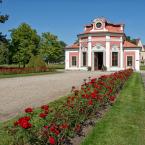
A small village with a hunting lodge built by architect Mikuláš Raimondi for Count František Josef of Wallenstein. In the surrounding landscape, you’ll find several wooden sculptures and land art installations, such as Sun Cradle, Nest of Giant Wasps, Unreachable Network, Three Kings, No One Left for This One, and Confrontation.
Mnichovo Hradiště
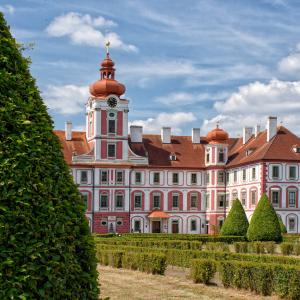
First mentioned in the 13th century, the town is associated with the Budovec family. At the beginning of the 17th century, Václav Budovec of Budov built a grand Renaissance chateau above the town, later remodeled in Baroque style. After his death, the estate passed to Albrecht of Wallenstein and remained in the family until 1946.
Today, the chateau is open to visitors and features historic interiors, a rare chateau theatre from 1833, the Church of the Three Kings, and the richly decorated Chapel of St. Anne with Albrecht’s tomb. In the chateau park, you'll find a sala terrena from 1711 and a statue of Václav Budovec created by Josef Bílek and Karel Lidický in 1937. The town museum, located in the chateau, features archaeological finds from the monastery, models of Drábské světničky, beehives from around 1850, folk architecture models, and artworks by local artists.
Other sights include the Baroque Church of St. James (1726), a Neo-Renaissance town hall, and an Art Nouveau post office.
Valečov Castle Ruins
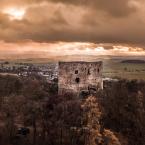
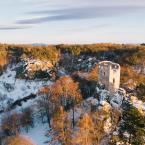
Once one of the largest rock castles in the region, Valečov was first mentioned in the 14th century and became a Hussite stronghold in the 15th century. It was abandoned in the first half of the 18th century. Visiting the ruins is not recommended for small children or people with limited mobility. However, nearby rock dwellings carved into sandstone can be viewed even without climbing to the castle — some of these were inhabited until the late 19th century.
An open-air summer festival, Valečovské kulturní léto, is held at the natural amphitheater below the castle. Refreshments are available at a kiosk near the castle and at the parking lot. A children’s playground is also located nearby.
Zásadka Castle Ruins
Originally a Gothic castle from the 14th century, later converted into a Renaissance manor, Zásadka now remains only as ruins. Located on a steep bluff above the confluence of the Jizera and Mohelka rivers, about 5 km from Mnichovo Hradiště, the site features remnants of moats, walls, and castle structures. In season, the local "castle lord" offers refreshments and shares the history of the place.